

Online Math Tutoring for School & College Students
House of Tutors offers live online math tutoring — also called online maths tuition — for students from primary school through college, taught by qualified, subject-specialist tutors who work with each student's actual level, curriculum, and goals.
Whether that means Primary Maths, O-Level, IGCSE, GCSE, A-Level, college-level coursework, or preparation for an entrance test, the right approach starts with understanding a student's level, curriculum, and specific learning needs.
Classes run one-on-one or in small groups, and every new student can start with a free trial class. No credit card required.
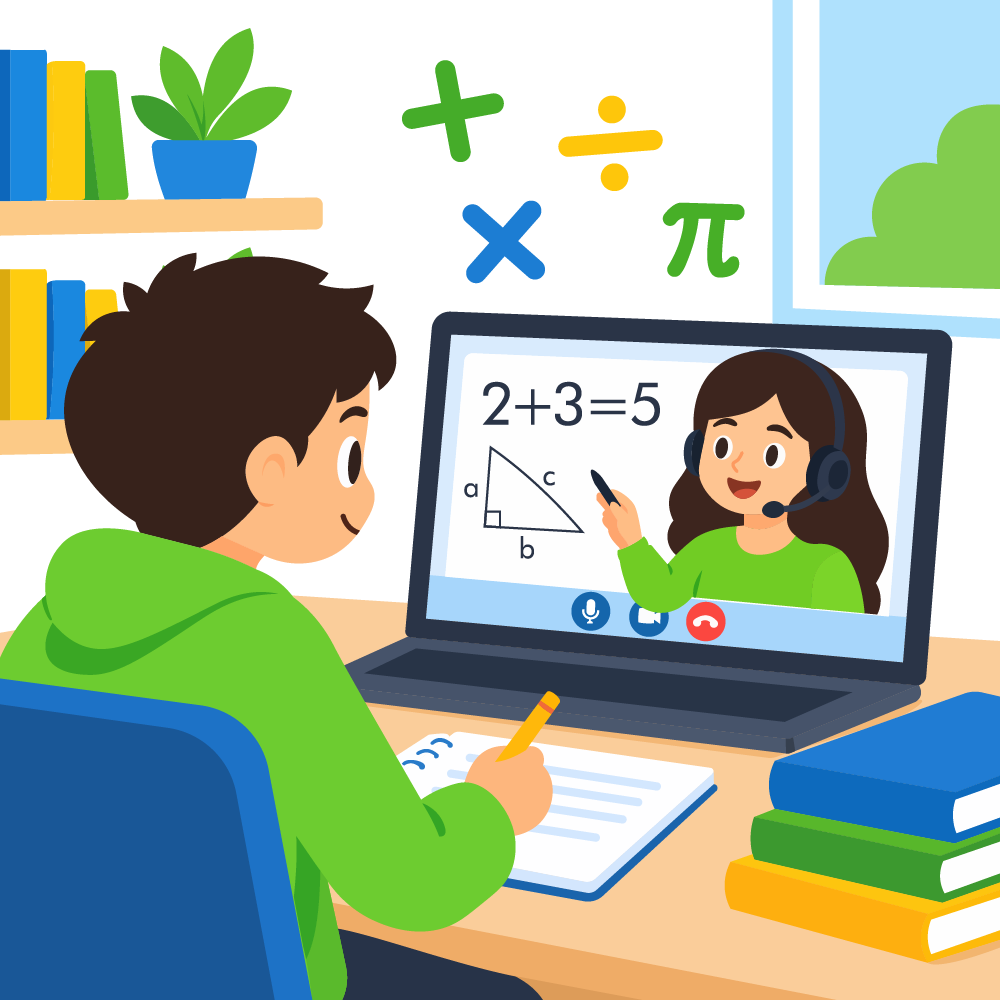
Math Tutoring for Every Stage — Primary Through College
Online math tutoring is available for every academic stage, from primary school through college, matched to where a student actually is rather than a one-size-fits-all lesson. Maths builds on itself, so this page is organized by stage to make it easy to find the right starting point.
Primary Maths
Primary maths tutoring focuses on the basics that everything else depends on: number sense, arithmetic, simple fractions, and early problem-solving. Getting this stage right builds the confidence a child needs before maths gets more abstract.
Middle School Maths
Middle school is where arithmetic starts turning into algebra, and where geometry and early data topics show up for the first time. Tutoring at this stage helps students bridge that jump instead of getting stuck on it.
Secondary Maths
This is the board-exam stage — the stretch of school leading up to a student's first major maths qualification, such as SSC, O-Level, IGCSE, or GCSE. Support here is built around the specific syllabus a student is following, not a generic curriculum.
High School Maths
This stage follows Secondary and leads toward university, covering more advanced work such as Algebra II, Trigonometry, and Calculus, often alongside university entrance preparation. Tutoring here tends to mix curriculum work with focused revision.
College Maths
College-level support covers the more advanced maths that comes with university coursework, including areas like college algebra and calculus. This is often where students need the most flexible, one-on-one attention, since college maths courses move fast and assume a lot of prior knowledge.
Math Topics You Can Get Help With
Online math tutoring at House of Tutors covers five core areas: Arithmetic, Algebra, Geometry, Trigonometry, and Calculus. A student doesn't need to know exactly which one is the problem before starting — sometimes maths just "isn't clicking," and that's a fine place to begin too.
Curricula and Boards We Teach
Tutoring is matched to a student's specific curriculum — Cambridge and international pathways, South Asian school systems, and the Common Core pathway — so lessons follow the syllabus a student is actually being examined on, not a generic one.
Cambridge and International Curricula
This covers O-Level, IGCSE, GCSE, and A-Level maths. These curricula share a similar structure and exam style, so tutors familiar with one are typically well placed to support students across the others too.
South Asian School Systems
This covers FBISE and provincial boards, along with CBSE and ICSE. Each of these has its own syllabus pace and exam format, and tutoring is matched to the specific board a student is enrolled in. The terminology varies too — grades 9–10 are often called Matric or SSC, and grades 11–12 FSc, Intermediate, or HSSC, while students following CBSE or ICSE typically refer to their Class 10 and Class 12 boards instead.
Common Core Pathway
This covers Common Core coursework and AP-level maths classes. The focus here is on the classroom curriculum itself — for SAT, ACT, or AP Calculus exam preparation specifically, see the exam preparation section below.
Math Exam and Entrance
Test Preparation
Exam-specific preparation is available separately from regular curriculum tutoring, covering school and board exams, university entrance tests, standardized tests, and competitive maths. There's a real difference between learning a subject and being ready to perform under time pressure, so this support is built around exam technique as much as subject knowledge.
School and Board Exam Preparation
For students approaching a major board exam, tutoring can shift toward focused revision: working through past-style questions, tightening up weak topics, and building exam technique alongside subject knowledge.

University and College Entrance Tests
Several university and college entry systems include a significant maths component, including ECAT, NUST NET, NTS NAT, the FAST entry test, UET entry test, and PAF entry test, as well as JEE Main, JEE Advanced, CUET UG, and NDA. Tutors work with the specific format and syllabus of whichever test a student is preparing for.

SAT, ACT, and AP Calculus
SAT and ACT Math sections test a defined range of algebra, geometry, and data topics under strict timing, while AP Calculus exams assess a full year of college-level calculus work. Preparation is matched to whichever of these a student is working toward, covering both the content and the pacing or format each exam demands.

Math Olympiad Preparation
For students aiming at competitive maths — olympiad-style problem sets rather than standard school exams — tutoring can focus on creative problem-solving and the less conventional question styles these competitions use.

What Kind of Math Help Do You Need?
Not every student needs the same kind of help — some need a concept explained again, some need homework support, some need structured revision, and some need ongoing support through the school term. Here's how tutoring adapts to each.
Understanding Difficult Concepts
Sometimes a topic was taught in a way that just didn't land. Tutoring gives space to have it explained again, differently, without the pressure of a full classroom.
Homework Help
Stuck on a specific problem set with a deadline tomorrow? Tutoring can offer focused, immediate support to work through it — not by handing over answers, but by walking through the method.
Practice and Revision
Understanding a topic once isn't the same as being able to use it reliably under exam conditions. Regular guided practice and structured revision help turn "I get it" into "I can do this consistently."
Ongoing Support
Some students do best with regular, continued tutoring rather than a one-off session — steady support that keeps pace with the school term and catches problems before they build up.
One-to-One or Group Math Classes?
Both one-to-one and group math classes are available, and the right format depends on what a student actually needs, not on which one sounds better.
One-to-One Tutoring
One-on-one classes are built entirely around a single student: their pace, their specific gaps, and their curriculum. This format tends to suit students preparing for a specific exam or working through a particular sticking point.
Group Classes
Group classes bring a small number of students together for the same topic. Some students learn well this way — hearing how classmates approach a problem, asking questions in a lower-pressure setting, and staying motivated by working alongside others.
Which Format Should You Choose?
It depends on what the student needs:
If a student needs...
Help with a specific learning gap
A pace tailored to them
Focused exam preparation
Collaborative, shared learning
A lower-pressure group setting
One-to-one
✓
✓
✓
Group classes
✓
✓
How Online Math Classes Work
Online math classes run live over video with a consistent tutor, using an interactive whiteboard to work through problems in real time — not pre-recorded lessons or a different teacher every session. Here's what that looks like in practice.
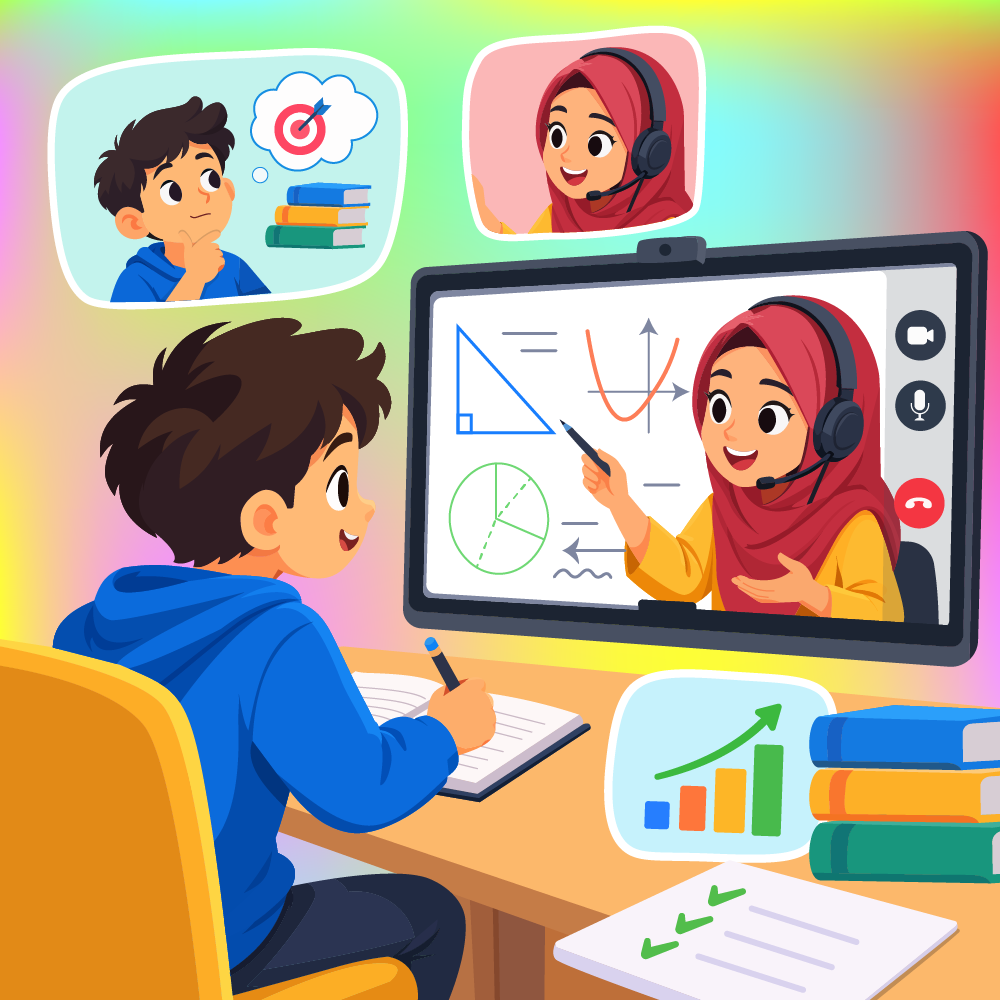
Start With Your Needs
Before anything else, a student's level, curriculum, and current struggles are identified, so the tutor knows exactly where to start.
Meet Your Tutor
Classes are led by a consistent tutor who gets to know the student's pace and learning style over time, rather than a different teacher every session.
Learn Through Live Classes
Sessions run live over video — typically through Zoom, Microsoft Teams, or Google Meet — using an interactive whiteboard so the tutor and student can work through problems together in real time, writing, drawing, and solving side by side, just as they would at a desk. Class materials are organized through a learning platform, so nothing gets lost between sessions.
Practise, Review, Continue
Each class is followed by practice and feedback, so learning doesn't stop when the session ends. Progress is reviewed regularly to keep the plan on track.
Qualified Math Teachers
Tutors are university graduates, and many hold a Master's degree in their subject. Teachers are matched to students based on subject expertise and the specific curriculum being taught, so a student working toward A-Level maths, for example, is paired with a tutor genuinely familiar with that syllabus. A qualification is a starting point, though — what matters just as much is whether a tutor's teaching style actually fits the student, which is exactly what the free trial below is for.

Try a Free Trial Class
A free trial class is available before committing to anything. No credit card required. During the trial, a student can:
- meet their potential tutor
- talk through their current maths level and what they're struggling with
- get a feel for how the online classroom actually works
- decide whether the teaching style feels right
How to Choose the Right Math Tutor
The right online maths tutor depends on a student's level, curriculum, topic, exam goal, preferred class format, and teaching fit — not on a single generic quality like "best" or "most experienced." A few honest questions make this decision easier:
- Academic level — where is the student right now, from primary through college?
- Curriculum — which board or syllabus are they following?
- Topic — is there a specific area causing trouble?
- Exam goal — is there a school exam, board exam, or entrance test coming up?
- Class format — would they learn better one-on-one or in a group?
- Teaching fit — does the tutor's style actually suit the student?
There's no single "right" tutor for everyone — the right one is the one that fits this particular student's level, goals, and way of learning. A free trial is often the easiest way to find out.
Frequently Asked Questions About Online Math Tutoring
Is online math tutoring effective?
It can be, particularly when a student gets the right level of instruction, consistent practice, and a format that actually suits how they learn. It isn't automatically better than in-person tutoring simply because it happens online — the quality of the teaching and the fit with the student matter more than the format itself.
How does online math tutoring work?
Classes take place live over video with an interactive whiteboard, led by a consistent tutor matched to the student's level and curriculum. Sessions are followed by practice, with regular progress reviews to keep things on track.
Is online tutoring as good as in-person tutoring for math?
Both formats can work well. Online tutoring offers more flexibility around scheduling and access to a wider range of tutors, while in-person tutoring offers face-to-face interaction. Which is "better" really depends on the student.
Who can benefit from online math tutoring?
School students working through a specific curriculum, college students tackling more advanced coursework, beginners building foundational skills, advanced students pushing further, and anyone preparing for an exam can all benefit, depending on their specific goals.
Can I get help with O-Level, IGCSE, or GCSE Math?
Yes — tutoring is available for all three, matched to the specific syllabus a student is following.
Can I get help with SAT Math?
Yes, SAT Math preparation is available, covering both the maths content and the exam's specific format and pacing.
Can you help me prepare for entrance tests like ECAT or JEE?
Yes. Preparation is available for a range of university and college entrance tests with a significant maths component, including ECAT, NUST NET, NAT, JEE Main, JEE Advanced, CUET UG, and NDA, matched to the format and syllabus of whichever test a student is preparing for.
Is online math tutoring suitable for college students?
Yes. College-level maths support is available for more advanced coursework, including areas like college algebra and calculus.
How do I choose the right math tutor?
Think about the student's academic level, curriculum, the specific topic or exam they need help with, and whether they'd prefer one-on-one or group classes. A free trial is a practical way to test the fit before deciding.
Can I learn math online one-to-one?
Yes, one-on-one online classes are available and are often the best fit for students with a specific gap to close or an exam to prepare for.
What math topics can I study online?
Arithmetic, algebra, geometry, trigonometry, and calculus are all covered, matched to the student's academic level and curriculum.
Start Learning Math Today
Whatever stage a student is at — catching up, keeping up, or getting ahead — the first step is the same: figure out their level, their curriculum, and what they actually need help with, then try a class and see how it feels. Book a free trial class with House of Tutors today. No credit card required.